


☄️ Black Holes & Wormholes: Are they shortcuts through space and time?
- Zehra Batool
- Jul 2, 2025
- 4 min read
Updated: Jul 4, 2025
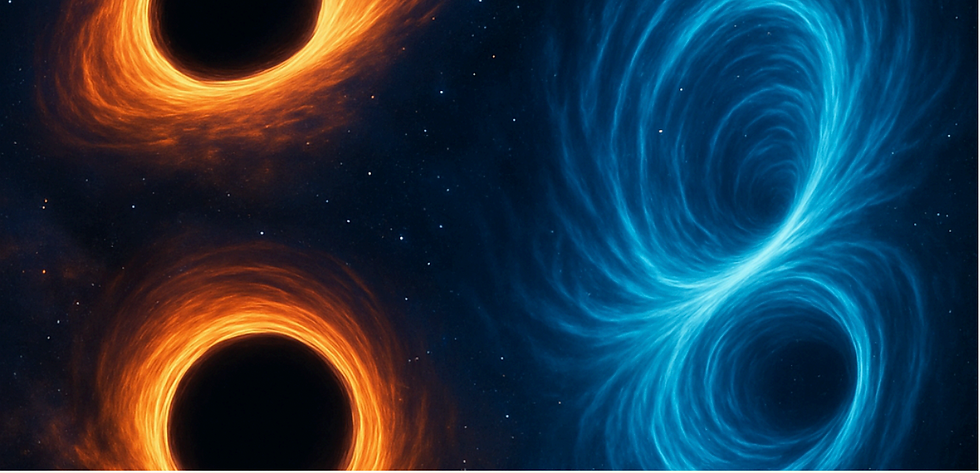
Ever wondered what happens in the universe beyond our line of sight — beyond the horizons that you gaze upon?
It wasn’t really possible to tell what goes on in that sky full of stars — but now, thanks to our
astronomers and the scientific brains of the 21st century, we’ve started to figure out some of the stuff happening out there.
And today we’re gonna talk about two of the wildest things space has to offer: black holes and wormholes. One’s real, one’s maybe real — and both will mess with your head.
So, what even are they? And how are they different?
Their definitions might sound simple, but what actually goes on inside them is way beyond
what most of us can fully grasp.
Let’s start with black holes — the ones we actually know exist.
Black holes are regions in space that form when a massive star collapses under its own gravity.
But that doesn't just happen overnight. First, a star burns through its fuel — hydrogen turning into helium through nuclear fusion, which is what keeps it alive and glowing. Over time, that fuel runs out. The pressure holding the star up can’t fight back against gravity anymore, so it starts to collapse.
Now, this happens differently depending on the star’s mass. Our Sun, for example, is too small to become a black hole — it'll become a white dwarf someday. But for stars that are around 20 times the mass of our Sun or more, the collapse is so intense that it forms a black hole — a point of such dense gravity that not even light can escape. Like, gone. Trapped forever.
But here’s the crazy part: what happens if you fall into one?
At first, time slows down — not for you, but for anyone watching from a distance. From their
point of view, you’d seem to move slower and slower, almost frozen near the edge of the black hole — which is called the event horizon. That’s because gravity here is so extreme, it warps time itself. It's called gravitational time dilation, and it’s one of those things that’s been proven, not just imagined.
And then comes the part called “spaghettification” (yes, that’s the actual term scientists use).
The gravity pulling on your head is stronger than the pull on your feet, so you start stretching —like literal spaghetti — as you get pulled into the black hole. Horrifying, yes. Fascinating? Also yes.
Now, there’s this popular idea that black holes might be teleportation portals. But is that true?
Not really. Once something passes the event horizon, it’s gone. Your body would get stretched and squished until it reaches what's called a singularity — a point where density becomes infinite and all known laws of physics break down. That’s where the phrase “point of no return” comes from. You don’t come out the other side. You don’t go anywhere else. You just... vanish into pure gravity.
Now let’s flip the coin and talk about something even more mysterious — wormholes.
Wormholes are like theoretical tunnels or bridges that connect two points in space and time.
They're often described as shortcuts — letting you travel across galaxies or even universes in
seconds. And while they sound like science fiction, the idea actually comes from Einstein’s
theory of general relativity. That’s real physics.
Here’s a way to picture it: imagine the universe is a flat piece of paper. You fold the paper so two distant points touch, then poke a hole through — that's your wormhole. It connects the two faraway points instantly, bypassing all the space in between.
So do they exist?
In theory, yes. We've never observed one — but the math says they’re possible. The real issue?
They’d be insanely unstable. If one formed naturally, it would likely collapse the moment
anything tried to pass through it.
To keep a wormhole open, scientists say you’d need something called exotic matter.
Exotic matter isn’t like the stuff we’re made of. It would need to have negative energy density, which basically means it would repel gravity instead of attracting it. This is the exact opposite of what regular matter does. Exotic matter could theoretically act as scaffolding — holding a wormhole open, keeping it from collapsing.
Now, we haven’t found any exotic matter in real life yet, but some quantum effects — like the
Casimir effect — hint that negative energy might actually be possible under very specific
conditions. So it’s not entirely out of reach... just extremely theoretical for now.
A great pop-culture example of this? The movie Interstellar. It shows a wormhole placed near
Saturn, which bends the space around it. The visuals in that movie, by the way, were so accurate they were actually used in real scientific papers. Yeah, Hollywood nailed that one.
Some theories go even deeper — suggesting wormholes could allow inter-universe or
intra-universe travel. That means you could jump not just across galaxies, but into entirely
different universes. The multiverse theory + wormholes = the ultimate sci-fi crossover.
So to sum it up:
Black holes are real, terrifying regions that suck in matter and trap it forever. Wormholes, on the other hand, are more like a cosmic “maybe” — a possible shortcut through space and time, if exotic matter exists to support them.
Both challenge our understanding of reality. Both are reminders that space is way weirder —
and cooler — than we ever imagined.
Mind. Blown.


Comments